
Which Landover Directories List People
Landover people directories do not sit in one city database. The community is unincorporated, so the best directory depends on whether the sought person served the county, worked at a school, appeared in a public filing, owned an assessed parcel, or lived here in an earlier era. Current institutional directories tend to show official contact details. Record indexes identify a person as a grantor, grantee, decedent, resident agent, licensee, or assessed owner. Library sources add past residents and local organizations.
| Landover directory | People or roles shown | Source keeper | How to reach it |
|---|---|---|---|
| County Staff Directory | Officials, departments, and listed staff | Prince George's County | Free public pages and directory |
| William Paca Faculty Directory | School faculty and staff | Prince George's County Public Schools | Free current web directory |
| UMD Directory | Faculty, staff, and opted-in students | University of Maryland | Public query with privacy limits |
| MDLandRec and Estate Search | Deed parties, decedents, and estate references | Maryland Judiciary, Archives, and Registers of Wills | Free indexes; MDLandRec account required |
| SDAT Property Search | Owner reached from an address or parcel key | Maryland SDAT | Free current assessment display |
| Business and license lookups | Resident agents, filing roles, and licensees | Maryland agencies and boards | Public web queries |
| HeritageQuest and Prince George's Room | Past residents, families, and people in local sources | PGCMLS | Catalog, library access, staff request, or consultation |
Start with the source that defines the relationship being checked. A county entry can confirm an official office contact, but it does not confirm a home address. A deed index links a party to an instrument, not always to occupancy. Historical directories are strongest when paired with a dated census, newspaper, deed, or assessment entry.
Landover Directory Boundaries Matter
A missing “City of Landover” directory is not a broken link. Landover is a census-designated, unincorporated community in Prince George's County. County agencies therefore provide the government, planning, election, library, assessment, and many other public directory layers that an incorporated city might keep for itself. Upper Marlboro is the county seat, so some record custodians and complete files are based there rather than in Landover.
Use PGAtlas when an address sits near a municipal or postal boundary. The parcel and geography view helps distinguish Landover, Greater Landover, North Landover, and Landover Hills. Historic sources may also use an older road, rural route, post office, election district, or neighboring place name. Directory searches should add those variants only when a dated address or source supports them.
Note: County and postal labels answer different questions, so confirm the legal boundary before choosing a government directory.
Landover Government Directory Entries
The Prince George's County Staff Directory is the appropriate local government directory for unincorporated Landover. Its interface separates Departments from People. Department browsing uses categories and telephone listings. People results can show a full name, title, department, institutional email, and work phone. County council, board, and commission pages may identify more public officials and their office contacts, though personal details can be withheld.
| Display name | The listed staff member's full public name |
|---|---|
| Title | The person's county role |
| Department | The agency or office tied to that role |
| An institutional contact address when published | |
| Telephone | A work number when the directory provides one |
These fields form a sample entry inventory, not a promise that each card is complete. If a name is absent, browse the department and use its main contact channel. Directory omission may mean the listing is suppressed, changed, or not indexed. It does not prove that the person never served the county. Maryland's state directory adds agency and public office contacts at the state level, but the county directory remains the local government starting point for Landover.
Landover School Faculty Directory
William Paca Elementary at 7801 Sheriff Road provides the strongest school-specific Landover directory found in the research. Its faculty page supports an optional name query, ascending or descending last-name sorting, and additional result loading. Staff cards may display a photo or placeholder, full name, profile link, title, department, institutional email, and phone. Visible department labels include Kindergarten, third grade, Health, and Administration.
| Directory control | Input | Required? | Purpose |
|---|---|---|---|
| Search for a staff member | Name text | No | Narrows the faculty cards by name |
| Faculty Search | Button | No | Submits the entered term |
| Last Name: A-Z | Sort control | No | Orders staff by surname ascending |
| Last Name: Z-A | Sort control | No | Orders staff by surname descending |
| Load More Results | Button | No | Reveals more directory cards |
The live William Paca faculty directory shows how these controls and cards are presented.
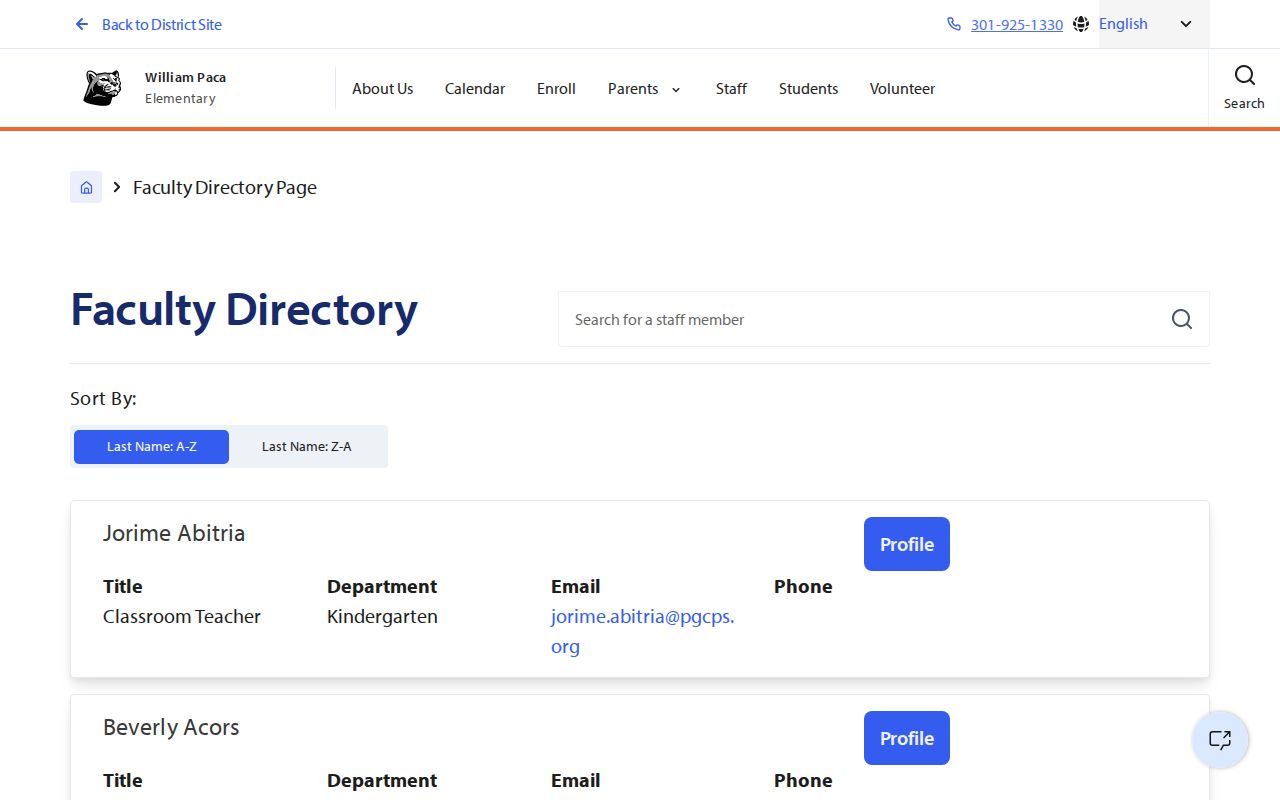
The capture anchors the school directory to an official Landover institution; a card confirms a school role and public contact, not where that person lives.
UMD Directory Near Landover
The University of Maryland Directory extends the education search beyond local schools. Its public query uses a name or search term and a Search button. Results may identify faculty, staff, and students who have not restricted display. A typical public institutional entry can include a display name, title or role, department, campus or business address, phone, institutional email, and a profile link.
That result confirms a published institutional affiliation. It does not establish a Landover residence. Privacy choices also matter. A missing entry can reflect suppression, departure, or an indexing issue rather than no prior link to the university. For former students, staff, or faculty, University of Maryland libraries and special collections hold regional manuscripts, university archives, newspapers, and yearbooks. Those archival sources are better suited to past affiliations than the current directory.
Note: Search both a full name and a supported shorter form, then verify the unit or profile before treating two similar names as one person.
Landover Public-Record Role Directories
Some official indexes work like Landover people directories even though each was built for a record function. Maryland Land Records lists grantors, who convey or encumber an interest, and grantees, who receive one. The statewide Estate Search can connect a decedent name to an estate number, date opened, county, status or type, and Register of Wills. The filing packet may then identify interested persons, a personal representative, addresses, inventories, claims, and distributions where public.
- Grantor
- A person or entity giving or encumbering a recorded property interest.
- Grantee
- A person or entity receiving an interest in the instrument.
- Resident agent
- The contact designated to receive legal process for a business, not necessarily its owner.
- Assessed owner
- The owner named on the property assessment account, which does not by itself prove occupancy.
Always keep the directory role beside the name. A deed-of-trust trustee is not necessarily the beneficial owner or resident. An estate party may be an heir, creditor, appraiser, or representative. Access rules and copy procedures belong with the broader Landover public records system, while these indexes are most useful here as narrowly defined name directories.
Why Landover SDAT Starts Elsewhere
Maryland's Real Property Data Search can reveal an assessed owner, mailing address, premise address, account number, map-grid-parcel key, legal description, deed reference, transfer details, and assessment data. Yet it cannot begin with a person's name. Official instructions also bar searching by town, neighborhood, subdivision, or ZIP. The accepted paths begin with a street address, property account identifier, or map reference; Prince George's County uses jurisdiction code 17.
A name-first search can instead use a deed, estate, court, business, or license index to find a supported address. Then SDAT can connect that address to the current assessment display. If the spelling is uncertain, official guidance says to omit a street direction and suffix and permits a trailing asterisk on a shortened street name. Keep the premise address separate from the owner's mailing address, since either may lead to a company, trustee, post-office box, or old correspondence address.
Landover Business and License Directories
The Maryland Business Express Entity Search is a name directory for legal entities and their filing roles. Search by exact legal name, a significant word, or department ID, then check former names and forfeited entities as well as active records. A result may show the entity name, department ID, status, formation or registration date, principal office, resident agent name and address, and links to filing history. The actual filing may be needed when the index does not identify the people behind an entity.
Maryland's Occupational and Professional Licensing pages route users to board-specific public checks. Health occupations use separate boards, and lawyers appear through the Maryland Judiciary or Attorney Grievance Commission directory. Verification commonly shows a name, license number or type, status, issue or expiration data, business address, and public discipline links where the board provides them. These professional directories prove a licensed or filing role. They do not prove that the business address is a home or that a resident agent owns the company.
Note: When names collide, compare the entity ID, board, license number, status, and filing image before joining records to one identity.
Landover Names in Library Collections
The Prince George's Room at the Hyattsville Branch is the main local-history fallback for Landover directory work. The noncirculating room holds historic newspapers on microfilm, county court proceedings, assessment books, Sanborn maps, local periodicals, photographs, and a microfilm reader. Researchers can ask staff for film or use the consultation form. Its catalog method is unusually precise: search an asterisk, then filter Assigned branch to “Hyattsville Branch [Prince George's Room Col.].”
| Collection | Period documented | Names or links it can supply | Access route |
|---|---|---|---|
| HeritageQuest city directories and census | Collection-specific; named federal census through 1950 is public | Residents, households, addresses, and family context | PGCMLS Discovery Suite; credential rules vary |
| County newspapers | Historic local issues; exact runs vary | Obituaries, notices, school names, sports, and organizations | Prince George's Room microfilm and staff request |
| Assessment books and court proceedings | Historical county records; series-specific | Taxable people, property links, and court parties | Room catalog, microfilm, or consultation |
| Wilfong property photographs | Buildings dating from the early 1600s through mid-1900s | Captioned houses, churches, taverns, and other county sites | 169 digitized photographs through Digital Maryland |
| City and reverse-directory research | Exact Landover years not verified | Past residents or occupants under suburban directory coverage | Ask staff to check publisher and title holdings |
The library's Discovery Suite identifies HeritageQuest as a source for family histories, genealogies, city directories, census data, and schedules. Remote or branch-only access varies. Ancestry is also advertised, but its current authentication terms should be checked before use.
Historical Landover Directory Eras
Historical Landover directories require a wider place vocabulary than modern portals. Landover may appear within Washington-area or suburban volumes rather than in a standalone city book. Older sources can instead organize people by plantation, tract, election district, post office, road, church, or nearby settlement. Exact publisher and reverse-directory years were not verified, so the sound fallback is to ask Prince George's Room staff to check the catalog by title and publisher instead of claiming a complete run.
| Period | Directory or record landmark |
|---|---|
| 1695 | Prince George's County formed from Calvert and Charles counties; earlier people may be indexed in predecessor or colonial records. |
| 1787-1802 | General Court land abstracts preserve parties, property descriptions, prices, and recording dates. |
| 1851-1924 | Prince George's Circuit Court land-record index series C1240 covers this archival span. |
| 1950 | The newest public named federal census schedule records the pre-Beltway Landover landscape. |
| Later years | City directories, newspapers, yearbooks, deeds, and assessment sources bridge the gap after the open census. |
The 1787-1802 abstracts were kept as insurance against loss or destruction, making them more than a simple directory. A party name can lead to a description, amount, and recording date when the original trail is hard to follow. For later occupants, compare a directory entry with census schedules, assessment books, deeds, obituaries, school sources, and dated maps. Churches, funeral homes, veterans groups, and civic bodies may also hold historic registers, but current member lists remain private unless the organization has chosen to publish them.
Note: A historical name match gains weight only when its date, address, role, and source agree with a second independent record.